
Finding the Real Bottleneck
Why speeding up one stage does not help when the work simply piles up somewhere else.

One of the biggest production jumps we have seen did not come from buying a faster machine.
It came from getting the entire line to move like one.
At Surterra Wellness, a Parallel company, one FlexPak line was producing about 20 trays a day with a four-person team. The machine was capable of more, but the workflow around it was not keeping pace.
That is where the FlexPak Assembly Line Workflow came in.
The workflow is not just a diagram showing where people should stand. It is a complete production system we have refined through years of running pre-rolls, tracking output and working with teams inside different facilities. It coordinates material prep, cone loading, machine operation, closing, QA and cone plate rotation so each station is ready when the work reaches it.
The goal is not to make every person look busy. It is to keep one slow or poorly timed handoff from starving the rest of the line.
Surterra reached out to FlexPak for help. During a 30-minute support call, we worked through the timing of every stage, helped the team establish a consistent FlexPak Assembly Line Workflow and recommended adding a fourth cone plate to the rotation.
“We went over the workflow and the timing for every stage. I took the notes straight back to the team, and we added a fourth cone plate. Once they got the feel for it, they went from about 20 trays in a day to 45.”
Same machine. Same size crew. One 30-minute call, one additional cone plate and a consistent assembly-line workflow took the line from about 20 trays to 45 trays a day.
More than double the output.
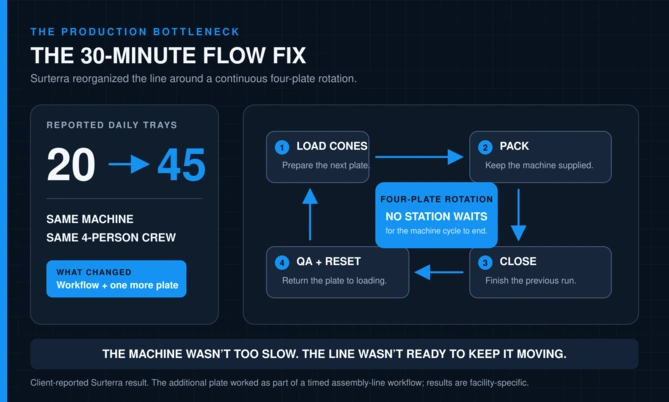
The fourth cone plate mattered, but the plate did not create that improvement by itself. It worked because the full line had been timed and organized around keeping plates in motion. While one plate was in production, the team was preparing the next plate, closing the previous run and handling QA instead of waiting for the machine cycle to end before deciding what happened next.
That is how FlexPak systems are designed to maximize output. The machine establishes the physical capacity. The Assembly Line Workflow helps a team use more of that capacity consistently, without throwing extra labor at the floor and hoping everyone figures it out.
The machine was not too slow.
The line was not yet organized to keep it moving.
That is the production bottleneck in plain English. It is the one step that limits what the entire line can finish, no matter how fast everything else looks on its own.
This is where equipment buying gets tricky.
When an order is running behind, the machine in the middle of the room is the easiest thing to blame. It is expensive, visible and usually has a number on a screen. Meanwhile, the actual constraint may be flower prep, paper loading, closing, QA, tubing, labeling or the simple fact that the next batch is not ready when the machine is.
A machine can hit its advertised rate and the order can still miss its ship date.
Manufacturers outside cannabis have dealt with this forever. The Theory of Constraints says the output of an interconnected system is governed by its limiting step. Lean value-stream mapping follows the work from order to delivery so operators can see where material waits, where labor gets tied up and where flow actually stops. NIST uses a similar reality check in overall equipment effectiveness: availability, performance and quality all matter. Speed by itself is only part of the picture.
Cannabis adds its own special touch because the raw material changes from batch to batch and sometimes seems personally offended by the production schedule.
The newest industry data points in the same direction.
The 2026 State of the Pre-Roll Market Report surveyed more than 125 pre-roll businesses in the United States and Canada. When respondents were asked which step took the most time, cone loading and twisting or folding tied for first at 24.4% each. Filling came in at 13.4%.
That matters. The machine most people call the “pre-roll machine” may not be working on either of the two most time-consuming jobs in the room.
It also lines up almost exactly with what our own production data has been telling us for years.
Across FlexPak’s production floor, customer installations and workflow reviews, two bottlenecks show up more than any others: loading empty cones fast enough and closing or crowning filled pre-rolls fast enough.
That is why our recent product development has focused on both ends of the machine instead of trying to make the filling cycle look faster on a spec sheet. We recently launched the FlexPak Auto Cone Loader to address the first constraint. Our automated joint closer, built to address closing and crowning, is coming soon.
We did not build them because the market needed two more shiny boxes. We built them because the production data kept pointing to the same two slow spots.
Neither tool replaces a properly designed workflow. But when cone loading or closing is the verified constraint, removing repetitive handwork from that step can keep the entire line moving and allow the crew to use more of the machine capacity it already owns.
The same survey found that 65.4% of reported rework came from two fill-related problems: inconsistent fill weight and pre-rolls packed too tightly or too loosely. So the constraint is not always the slowest physical motion. Sometimes it is the step sending the most product back for another touch.
There is a useful example in Custom Cones USA’s cone-filling-machine report. In its supplier-run comparison, a 121-slot machine completed 837 filled-and-closed cones per hour with one operator. A competing 169-slot machine completed 585. With a second operator and spare filling components, the results rose to 1,361 and 1,170 finished cones per hour, respectively.
That was not a neutral academic study, and it should not be treated like one. But the operational lesson is still worth noticing: the machine with more holes per cycle did not produce more completed units in the test. The closing method and the way labor moved around the machine changed the result.
More capacity at one step does not automatically create more throughput. Sometimes it just creates a larger pile in front of the next step.
Full automation doesn’t eliminate bottlenecks. In many cases, it connects more production steps together, which means the slowest section still controls the line.
We saw that firsthand with a large Florida MSO that later became a FlexPak customer. Its Eight-Channel JuanaRoll required five to six people across material preparation, machine operation, feeding, mechanical oversight and QA. The operation averaged roughly 12,000 to 13,000 finished, approved pre-rolls per day. Its best reported day was approximately 15,000.
The machine could move quickly when every part of the process stayed perfectly supplied and timed. But material preparation, feeding, clearing stops and correcting finished units determined what the facility actually walked away with.
The same company also operated an ActionPac line with eight people involved because closing still had to be handled outside the machine. Filling was not necessarily the problem. Finishing the pre-rolls was.
A separate operator quoted in the Custom Cones USA machine report described the same issue with a Hefestus automated line. The system produced approximately 100,000 units per month while running for about half the month, but the operator said post-process touch labor became the biggest bottleneck.
Automation didn’t remove the bottleneck. It moved it somewhere else in the process, then made the entire connected line depend on that step.
This isn’t unique to full automation. We’ve watched bottlenecks move around FlexPak production lines too.
Modern Distribution originally had eight to ten people producing roughly 8,000 pre-rolls a day with knockboxes. Manual capping was the drag on the line. After moving to FlexPak, a two-person core crew reported about 20,000 packed-and-closed pre-rolls a day on one machine once the process was calibrated.
Then the bottleneck moved.
With filling and closing no longer holding the line back, manually loading cones into production plates became the next constraint. That led Modern to add an Auto Cone Loader. In its interview, the team reported roughly three minutes to prepare a loader tower and about 20 seconds to release a layer into the production plate. It also reduced the regular two-machine crew from four people to three.
We are not attaching a full-day output increase to that change because Modern had not yet run enough comparable, full-demand shifts to support one. The verified result was narrower and still valuable: less repetitive loading work and one operator freed from the two-machine cell.
That is how bottleneck work is supposed to function. Fix the constraint, measure again and expect the constraint to move.
My Friend Processing saw a similar shift. Its four-person integrated line, using two FlexPak machines, reported about 22,000 retail-ready pre-rolls a day. That number includes grinding, sifting, loading, filling, packing, closing, tubing and labeling, which is a different production boundary from a packed-and-closed figure.
Once the fill-and-close workflow was moving, paper loading became the hold-up. The team reported that manually loading one plate took about six minutes. With the Auto Cone Loader, the same task dropped to roughly one and a half to two minutes, a 67% to 75% reduction in task time.
“We use it every day. The trays are loaded in a minute and a half to two minutes instead of someone standing there for six. They’re not waiting for trays anymore.”
Again, an important line in the sand: the 22,000-unit benchmark came before the loader was installed. It would be misleading to credit that daily output to the loader or claim a matching percentage increase in total production. Removing 75% of the time from one task does not remove 75% of the time from the entire line.
It removes time from that task. Then you watch what happens next.
Rebel Roots Farms described the same principle from another angle. On its line, the goal was not to make each person look busy. The goal was to keep the production step that mattered from waiting.
“The philosophy was to prioritize loaded plates so the operator never stopped producing. We had people preloading cones while others closed. As soon as one plate came out, the next went into the machine.”
That facility reported 20,000 to 30,000 packed-and-closed pre-rolls a day from one FlexPak with a three- to four-person machine-level crew. Those figures do not include every possible downstream retail-packaging task, so we are not presenting them as retail-ready output.
Perpetual Brands gives us the opposite view of the same issue. During one documented week, two primary FlexPak operators produced 69,519 pre-rolls. They were supported by one material-prep employee and an eight-person tubing, labeling and case-packout team.
That does not mean it took eleven people to operate two machines. It means a real commercial order continued well beyond the machine. The filling cell, material-prep function and final packout area were three separate capacity pools. If one fell behind, the others eventually felt it.
This is why production boundaries matter so much. “Produced” can mean filled. It can mean packed and closed. It can mean passed through QA. Or it can mean tubed, labeled, cased and ready to ship.
All four numbers may be useful. They are not interchangeable.
Before buying more equipment, spend one normal shift finding out where your own line actually stops. Not a trade-show run. Not the cleanest strain in the vault. A regular production day with the product and people you normally use.
- The net minutes available after planned setup, breaks, cleaning and changeovers
- Units entering and leaving each step
- How long material waits before each step
- How long a station is starved because the next batch is not ready
- How long a station is blocked because the following step cannot accept more work
- Rejects, rework and manual touch-ups by source
- Paid labor hours at each step
- Packed-and-closed output separately from retail-ready, accepted output
The worksheet is not glamorous. Neither is making payments on a machine that spends half the shift waiting for cones.
Then compare the line to the actual order.
Lean manufacturing uses takt time for this:
Available production time ÷ customer demand = time available per accepted unit
If an order requires 20,000 accepted pre-rolls during a shift with 420 net production minutes, the line needs to average one accepted unit every 1.26 seconds, or about 2,857 accepted units per hour. Batch equipment can reach that average in groups rather than one unit at a time, but every connected step still has to support the required pace.
Now imagine the filler can produce 4,000 units per hour, closing can sustain 1,500 and final packaging can sustain 1,000. Ignoring downtime and rework, the packed-and-closed ceiling is 12,000 over eight hours. The retail-ready ceiling is 8,000.

Buying an even faster filler would not change either number.
That example is intentionally simple, but it exposes the mistake. Facilities often compare the advertised capacity of one machine to the demand for the entire order. Those are two different calculations.
Sometimes the machine really is the bottleneck. If it is constantly supplied, rarely blocked, producing acceptable quality and still cannot keep pace with demand, more machine capacity may be exactly the right investment.
But if it spends the day waiting on ground flower, loaded papers or a buried closing table, you do not have a machine-speed problem yet.
You have a flow problem.
Find the pile. Find the person waiting. Find the units coming back for rework. That is usually where the next dollar and the next process change belong.
Then measure again, because the bottleneck will move. It always does.
A fast machine can make more pre-rolls.
It can also make a bigger pile in front of the slow step.
Do not buy speed for the step that is already waiting.
Part 7 is next: Cannabis Material Variability. Because even after you balance the line, the flower can change the rules before lunch.
See the real numbers on a FlexPak line.
The FlexPak Max and Edge deliver up to 49,248 packed-and-closed pre-rolls per shift with a 2–3 person crew. USA-built, no mandatory service contract, lifetime technical support.