
Questions to Ask Before Buying a Pre-Roll Machine
The practical equipment-buying checklist we wish someone had given us before we spent more than $250,000 learning these lessons the hard way.
Nine parts in, we've spent enough time talking about how pre-roll equipment purchases go sideways.
For the last one, let's make sure yours doesn't.
We're ending The Automation Trap with the buyer's guide we wish someone had handed us before we spent more than $250,000 learning these lessons ourselves.
This series was never about bashing full automation. Full automation works extremely well for some operations. If you have consistent material, predictable demand, a focused SKU mix, trained maintenance staff and enough capital to support the complete system, it may be exactly what you need.
We've also seen too many companies discover it wasn't right for their operation after the six-figure check cleared.
Some eventually got the machine dialed in. Some bought more equipment to support it. Some purchased semi-automated machines as backup. Others quietly stopped using the automated system altogether.
We know what that feels like because we lived it.
We didn't ask enough questions before we started writing checks. So this final part isn't another argument about which machine is better.
It's about making sure you know what to ask before deciding for yourself. And if you're not sure how to answer some of those questions yet, that's okay too. Getting a clear picture of your production floor is part of the process.
Start With the Output You Actually Need
The short version is this:
When comparing commercial pre-roll machines, don't start with how automated they are. Start with the finished, accepted output your business needs, then work backward through the labor, production time, material requirements, formats, downtime risk and total cost required to reach it.
The first question is not how fast the machine runs.
It is: What job does the business actually need finished?
Write down your normal monthly volume, your highest realistic volume and what production looks like during a slow month.
How many finished, accepted pre-rolls do you need? How many production days are available? Which formats and weights are required? How many people can realistically be assigned to the process?
Then look a year ahead.
What happens if a co-packing customer places a 500,000-unit order? Can you accept it? What happens if the following month drops back to 200,000? Can you reduce the equipment and labor being used, or are you now dragging the full investment around the facility whether you need it or not?
Cannabis has never been especially respectful of anyone's forecast.
Buying only for today's average can leave you short when sales grow. Buying one oversized system for the biggest month you can imagine can leave a very expensive machine waiting for demand to return.
The right production system should make sense across the range.
Define What the Output Claim Actually Counts
Next, define exactly what the output claim counts.
Does the advertised number represent machine cycles, filled papers, packed-and-closed pre-rolls, accepted pre-rolls or completely retail-ready units?
Those are not interchangeable numbers.
Find out whether rejected units have been removed, whether reworked units are counted again and whether the shift total includes loading, refills, cleaning, adjustments, breaks and changeovers.
Most importantly, find out whether the production number came from one strong hour or an entire working shift.
There is nothing wrong with an “up to” number. We publish them too.
But “up to” needs a boundary around it.
What material was used? What weight and format were being produced? How many people supported the process? What happened when the material changed? How much of the output passed QA?
If the financial model is based on the machine's best hour multiplied by eight, you may not have a production plan.
You may have a very expensive best-case scenario.
Count the Complete Crew
Then count the complete crew.
The person standing at the control panel may technically be the machine's only operator. That does not mean one person is completing the order.
Someone may still be milling and sifting flower. Someone loads cones or papers. Someone keeps material moving. Someone clears stops. Someone watches the finished product. Someone checks weights, repairs closures and handles rework.
They're on the schedule. They're on the payroll. If the machine needs their work to hit the production number, they belong in the labor model.
The most useful calculations are simple:
Total workflow labor hours ÷ finished, accepted output
And:
Finished, accepted output ÷ everyone involved in that workflow
That gives you something much more useful than the number of people standing closest to the machine.
It gives you actual labor productivity.
The U.S. Bureau of Labor Statistics defines labor productivity as output compared with the labor hours used to produce it. That same basic discipline belongs on a pre-roll floor.
Fewer people do not automatically mean lower labor cost.
A smaller crew can still become expensive if it takes the entire month to finish the order.
How Long Does It Need Them?
That brings us to the production calendar.
If one crew can finish production in ten days and another needs twenty-five, the first crew may be larger while it is running. It also becomes available much sooner for packaging, fulfillment, inventory or another production department.
That matters in facilities where employees are cross-trained and capable of doing more than standing beside one machine all month.
The labor question isn't only, “How many people does this take?”
It is also, “How long does it need them?”
Look at the Material
Now look at the material.
Cannabis does not become uniform because the machine prefers it that way.
Flower changes between strains, batches and rooms. Moisture changes. Bulk density changes. Grind size changes. Resin content changes. Infused material introduces another set of variables.
A machine may run beautifully with carefully prepared demo material. The more important question is what happens when your material moves away from that ideal condition.
Does the machine keep running? What happens to output, weight accuracy and finished quality? How many rejects are created? How much adjustment, cleaning or additional material preparation is required?
Don't ask only whether a system can run sticky flower or infused material.
Ask what it produces while doing it.
If a machine requires a narrow moisture, grind or density range, that doesn't automatically make it a bad machine. It makes those specifications part of the production process.
That preparation time and labor belong in the math too.
Look at Your Formats
Then look at your formats.
Maybe cones make up nearly all your business today. What happens if your largest customer asks for straight-wall pre-rolls next quarter? Can the same system produce blunts, dogwalkers, infused SKUs or different target weights?
What requires new tooling? What does the tooling cost? How long does a real changeover take? Can different SKUs run at the same time, or does the entire line stop every time the product changes?
We watched this happen with Perpetual.
CEO Dan P. explained that changing formats on the FlexPak involved changing the plate, a process his team could handle in about ten minutes. He also reported strong results with 0.5-gram and one-gram infused products that had been difficult to run through previous equipment.
During one documented week, two primary FlexPak operators produced 69,519 pre-rolls, supported by one material-preparation employee and a separate downstream retail-packaging team.
That distinction matters.
We're not calling it a two-person retail-ready operation when additional people were involved elsewhere. The point is that the production system allowed the company to expand its SKU mix without rebuilding the entire line every time the product changed.
Your equipment should support the market you have today without trapping you inside it tomorrow.
Find the Actual Bottleneck
After that, find the actual bottleneck.
It may not be the filling machine.
The real constraint could be milling, sifting, cone loading, paper loading, closing, crowning, QA or final packaging.
At Surterra Wellness in Florida, a 30-minute workflow conversation and one additional cone plate helped the team move from roughly 25 trays a day to approximately 45 to 50.
The packing machine itself hadn't suddenly become faster.
The workflow stopped starving it.
That is the kind of problem a brochure output number cannot reveal.
Walk one batch from raw flower to the point your facility calls finished. Record where material waits, where employees wait and where work begins piling up.
The fastest machine in the building cannot outrun the slowest required step forever.
Sometimes a producer needs another machine.
Sometimes the better answer is another plate, a different handoff, moving one employee or changing the order in which the work gets done.
That may not be as exciting as unpacking a new piece of equipment, but neither is discovering that the new machine wasn't the problem.
Model the Bad Day
Then model the bad day.
The machine will eventually need cleaning, adjustment, maintenance or repair. That doesn't make it a bad machine. It makes it commercial equipment.
Understand what maintenance is required daily, weekly and monthly. Find out which production stops are most common, which ones your crew can handle and which require outside support.
Where are replacement parts stocked? What should remain onsite? What is the realistic support response time during your production hours?
Then calculate:
Units at risk = accepted output per hour × expected outage hours
Contribution margin at risk = missed accepted units × contribution margin per unit
Recovery time = missed units ÷ spare accepted capacity per day
Repair time and business recovery time are not always the same thing.
A machine may be fixed in one day, but the production floor can spend the rest of the week working through everything that piled up while it was down.
Dan P. put it more plainly when we spoke with him:
“Two days of downtime hurts. I notice that in my end-of-month sales numbers.”
That is why Part 9 focused so heavily on modularity and remaining capacity.
Never model only what the facility can produce when everything is working.
Ask what the facility can still produce when the main unit makes zero.
Rebel Roots Farms built its production workflow around mainly five FlexPak machines. Dean S. reported peak production of as many as two million pre-rolls in a month.
A sixth machine could be brought online when orders required all six or when one of the regular five needed to rotate out for cleaning or tuning.
When demand slowed, the operation could drop down to two, three or four machines and bring the remaining capacity back online when orders returned.
That gave Rebel Roots surge capacity and maintenance capacity without forcing the company to run one oversized system every day simply to justify owning it.
Surterra took a similar approach with two separate FlexPak Max production lines.
David B. reported approximately 25,000 to 27,000 pre-rolls from each line during a scheduled 10-hour production day, with approximately 48,000 to 50,000 combined and less than 1% rejects.
One line could produce 0.35-gram dogwalkers while the other handled 0.5-gram and one-gram cones. One could also continue working while the other was cleaned or adjusted.
Those figures are client-reported and have not been independently audited. Different facilities will get different results based on their material, crew, formats and workflow.
That is exactly the point.
The goal is not to copy another facility's production number. It is to understand how the equipment behaves inside the type of production system you intend to build.
Modularity is not exclusive to semi-automation. A company can create redundancy with multiple automated lines too.
The question is whether the economics allow it.
Buying a second six-figure machine mainly so the first one is allowed to have a bad day is a very different capital decision from adding another smaller production cell.
Count the Full Investment
That leads to the full investment.
Do not stop at the purchase price.
The real number includes the equipment, required modules, format-specific tooling, freight, installation, training, facility modifications and material-preparation equipment. It also includes complete workflow labor, maintenance, replacement parts, support, cleaning, changeovers, rejects, rework, material loss, downtime, financing and the labor required to catch back up.
Then calculate the number the business actually lives with:
Total production-system cost ÷ finished, accepted pre-rolls
That is the cost worth comparing.
Not machine cycles. Not the cleanest hour from the demonstration. Not an operator count that ends at the control panel.
Before making the final decision, run the investment through a normal month, a peak month, a slow month, a difficult-material week and a multi-day equipment outage.
If the financial case only works at maximum production, with perfect material and no meaningful downtime, it may not be as safe as the ROI calculator suggests.
Ask for Evidence
Then ask for evidence.
Whenever practical, watch the equipment operating in a licensed facility. Ask the manufacturer to connect you with a nearby operator running similar formats and volumes.
When you speak with an owner, don't ask only about the best day.
Ask about the worst production week.
How many people were actually involved? What material gave the machine trouble? What parts do they now keep in the building? How responsive was support when production was waiting? What would they purchase differently if they were starting again?
The answer usually teaches more than the best production hour.
Put Six Numbers on One Sheet
Before approving the purchase, put six numbers on one sheet: your normal monthly volume, peak monthly volume, finished accepted output per shift, total workflow labor hours, reject and rework rate, and the capacity remaining if your primary machine is down.
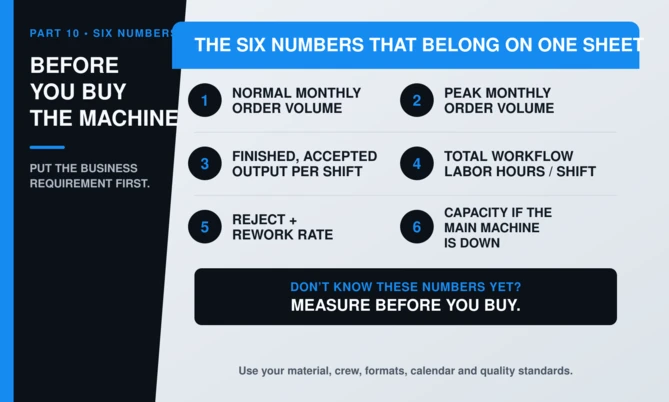
If you don't know those numbers yet, that's fine.
It just means the next investment should probably be time spent measuring the operation, not money spent buying another machine.
Once you have the numbers, score each system you're considering.
A simple 100-point framework looks like this:
- Finished output and quality: 20 points
- Complete workflow labor: 15 points
- Material compatibility: 15 points
- Format and SKU flexibility: 10 points
- Uptime, support and recovery: 15 points
- Modularity and scalability: 10 points
- Total economics: 15 points
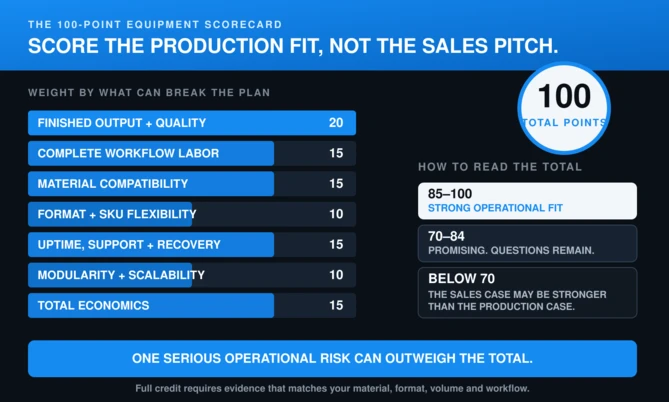
Do not give full credit for a verbal promise.
A top score should require production evidence that reasonably matches your material, formats, volume and workflow.
A score between 85 and 100 suggests a strong operational fit. From 70 to 84, the system may be promising, but the unanswered questions still need work. Below 70, the sales case may currently be stronger than the production case.
The score is not a substitute for judgment. One serious operational risk can outweigh a strong total.
There are also a few signs that should make you slow down.
Maybe the shift number is the best hour multiplied by eight. Maybe nobody can clearly explain what the advertised output counts. The crew estimate may exclude required prep, loading, QA or rework. Rejects are missing. Material requirements remain vague. Nobody wants to discuss common stops, replacement-part availability or support response times.
Maybe the ROI model uses retail sales instead of contribution margin. Maybe the entire financial case depends on running at maximum volume. Maybe there is no plan for a surge month, a slow month or an outage. Maybe you cannot speak with a current operator running anything similar to your production floor.
None of that automatically means you should walk away.
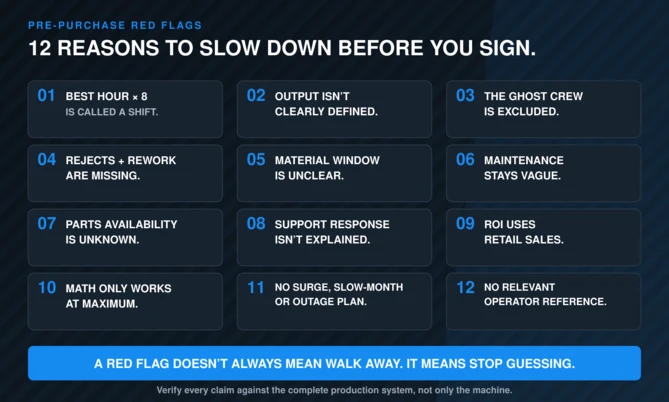
It means you should stop guessing.
Why We Built This
We started The Automation Trap because we learned these lessons the expensive way.
We spent more than $250,000 chasing equipment that promised more output, less labor and an easier production day. Some of it worked under the right conditions. Too much of it failed to deliver what our operation actually needed.
But somewhere along the way, this stopped being only our story.
We spoke with producers across the United States and Canada who had lived their own versions of it. Some love their fully automated equipment and run it successfully every day. Others have purchased modular systems as backup. Some have retired their automated lines completely.
There is no single machine that is right for every facility.
There is only the machine, and the complete production system around it, that makes sense for your flower, your crew, your formats, your orders and your margins.
The cannabis industry is tough.
Margins move. Regulations change. Customers change direction. Large orders appear and disappear. Capital is difficult to raise and even harder to replace once it has been spent.
We've all watched smart, hardworking people build something real and still lose it.
Not because they were careless. Not because they didn't work hard enough. Sometimes a few reasonable decisions made with incomplete information simply start stacking up against them.
A six-figure equipment mistake doesn't sit quietly in the corner of a spreadsheet.
It can reach payroll, delivery dates, customer relationships, inventory and every other part of the operation that needed that money.
That is why we're serious when we say we want to help.
If you're comparing fully automated and semi-automated pre-roll machines and need a second set of eyes on the numbers, we'll look at them with you.
If you already own equipment and cannot understand why production isn't reaching the output you expected, we'll help you trace the workflow.
If the crew is working hard but trays keep piling up at one station, everyone keeps waiting on the same handoff or the machine spends half the day waiting to be fed, we'll help you look for the bottleneck.
Maybe the answer is another machine.
Maybe it's another plate, reorganizing the production cell, improving material preparation, fixing the closing process or moving one person twenty feet across the room.
And if all you want is an honest conversation about how to evaluate the options in front of you, we're here for that too.
It does not have to begin or end with buying a FlexPak.
If FlexPak fits the operation, we'll show you why the numbers make sense. If full automation is the better decision, we'll tell you that. If the equipment you already own can do the job and the real problem is workflow, that may be the most useful answer we can give you.
We have nothing to gain by putting FlexPak into a facility where it doesn't belong.
We built these machines because we had our backs against the wall and had to fight our way toward better production.
We remember what it feels like when equipment isn't doing what the business needs, orders are waiting, the crew is frustrated and there is no obvious answer. We remember trying to decide whether the solution was another machine, more people, another adjustment or simply starting over.
That experience is why FlexPak exists.
If some of what we fought through can help another producer avoid that position, then this series did what it was supposed to do.
To everyone who read all ten parts, challenged a number, shared an experience or trusted us with what really happened after the salesperson left the building, thank you.
We genuinely hope this series helps you ask better questions, catch bad assumptions and make the right investment for your business, even if that investment isn't with us.
If the math supports full automation, buy it.
If the math doesn't, listen to the math.
The machine does not have to win the demo. It has to finish your orders.
Read the complete 10-part Automation Trap series here: The Automation Trap
See the real numbers on a FlexPak line.
FlexPak Max and Edge Enterprise packages deliver up to 49,248 packed-and-closed pre-rolls per 8-hour shift. Staffing depends on the package and production workflow. USA-built, no mandatory service contract, lifetime technical support.