
The "One-Operator" Claim
The prep, feeding, troubleshooting and quality-control crew missing from the operator count.
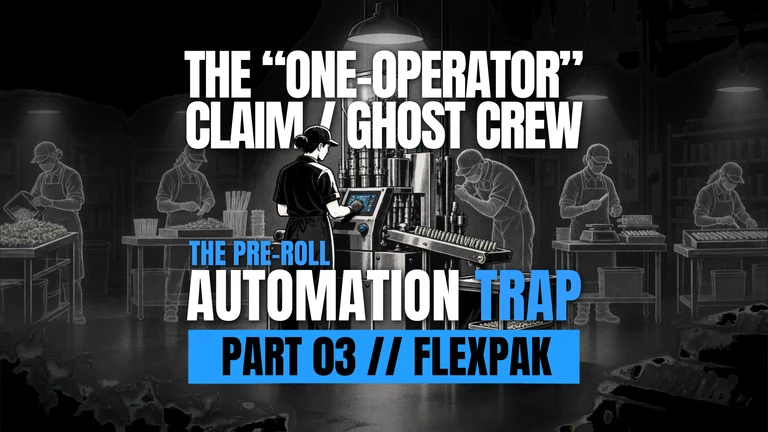
We've seen fully automated pre-roll machines run by one operator.
We've also seen seven people on the schedule to keep one of those machines producing.
That's the part we wish somebody had explained before we started buying equipment.
“One operator” usually tells you how many people need to stand at the machine. It may be completely accurate. But if you're building a labor budget, you need to know who's preparing the flower, loading cones or papers, keeping the machine fed, dealing with stops, and checking or fixing what comes out.
That's the ghost crew. They're on the schedule. They're on the payroll. They're just not in the machine's operator count.
We're drawing a line around pre-roll production here, from material prep through a pre-roll that passes quality checks. Tubing, labeling and final retail packaging come later. They take labor too, but we're leaving them out of this comparison so we're counting the same stages for every setup.
Before we built FlexPak, we bought equipment expecting one or two people to make around 20,000 pre-rolls a day. We planned around that. One person did run the machine, but another stayed close to deal with stops before they backed everything up. We had people grinding and sifting flower, preparing cones and keeping material ready. At the other end, people checked weights, fixed closes and sorted out what passed.
Trying to get anywhere near 15,000 a day took roughly seven people. Sometimes an eighth floated in when we really needed to push.
The machine hadn't suddenly become an eight-operator machine. Our order had become an eight-person job.

You can see why the wording matters even in manufacturers' own material. Hefestus says one operator can run its AuraX. Its Seed & Smith case study describes a successful production setup making 10,000–15,000 pre-rolls a day with two trained operators. Both statements can be true. The question for a buyer is what work each number includes, and who handles the steps outside it.
David B., an operations manager at Surterra Wellness, a vertically integrated Parallel (MSO) operation in Florida that now uses FlexPak, gave us a firsthand example when we interviewed him recently. Before switching, his team ran an eight-channel JuanaRoll. He said it took five or six people across the work needed to keep that setup producing.
Over a scheduled ten-hour shift, including normal breaks, they averaged 12,000–13,000 packed-and-closed pre-rolls. Their best shift ended with 15,000 approved pre-rolls.
“There were only a few times where we really hit 15,000 pre-rolls on that machine, and that was a good day.”
David B. also described a separate ActionPac setup that involved eight people, partly because closing still had to be done by hand. Those were the crews in his facility. We're not claiming every operator of either machine needs the same staffing. But if you'd put one or two people into a cost forecast for his operation, you would have missed most of the people doing the work.
His description of the problem was pretty direct: “The biggest issues were labor, downtime and consistency.”
It isn't only our experience. In a walkthrough of Kaprikorn Cannabis's production floor, the production manager describes two operators running two RollPros Blackbird machines, plus two additional grinders preparing material for them.
That's four people involved before you even get into who checks the rolled joints. One Blackbird operator says they normally roll around 5,000 joints per machine per day. The company was happy with its setup and preparing to add a third machine.
The point isn't that Kaprikorn is doing anything wrong. It's that the two grinders are part of what keeps those two operators producing. And the 5,000 figure is joints rolled, not a reported count of joints that passed final checks.
So how do you keep the ghost crew from disappearing in your math? Add up the paid hours spent on material prep, feeding the machine, loading cones or papers, machine operation, mechanical oversight, quality checks and rework. Then divide that by the pre-rolls that passed:
Direct labor hours per 1,000 approved pre-rolls = (paid production hours through final quality checks ÷ approved pre-rolls) × 1,000
Take David B.'s best JuanaRoll shift as an illustration. If all five or six people spent their full paid ten hours on those production stages, that's 50–60 paid labor hours for 15,000 approved pre-rolls. It works out to 3.3–4.0 labor hours per 1,000.
Count only one person for those ten hours, and it looks like 0.67 hours per 1,000. At an illustrative $20 an hour, that's about $13 per 1,000 on the one-person estimate versus $67–$80 per 1,000 with the full crew counted.
Same best shift. Same approved output. A very different number to put in your production budget.

That example assumes everyone was paid for the full scheduled shift and worked on the stages we're counting. Paid breaks count as paid time; unpaid breaks don't. If someone split their day between production and another job, you'd count only their production hours.
We also can't use the 12,000–13,000 packed-and-closed average to calculate an average cost per approved unit without knowing how many passed quality checks on those days.
We have to apply that same rule to ourselves. David B. runs two FlexPak lines, each with one machine and a four-person crew handling every aspect of pre-roll production through quality checks. Together, those eight people produce roughly 48,000–50,000 pre-rolls over a scheduled ten-hour day. We count all eight because all eight are part of that output.
That's one facility with its own team, flower and way of working. Another facility might reach the same output with fewer people. Another might use more people and produce less.
The point is to track every hour and every stage, then see where time, labor or product is getting lost. That's where you find room to improve your margins.
Full automation can potentially save a company labor costs. But pre-roll production is a fractured process. There's work upstream of the machine and work downstream, and those hours don't disappear because one person can run the controls.
Before buying any pre-roll solution, fully automated or semi-automated, find out who does that work, how long it takes and how many approved pre-rolls the whole crew produces.
If the ghost crew is missing from your math, you don't know what labor you're saving.
If the ghost crew is missing from your math, you don't know what labor you're saving.
See the real numbers on a FlexPak line.
The FlexPak Max and Edge deliver up to 49,248 packed-and-closed pre-rolls per shift with a 2–3 person crew. USA-built, no mandatory service contract, lifetime technical support.