
Format and SKU Flexibility
What happens when customer demand moves from cones to dogwalkers, straight-wall joints, blunts or another format your equipment cannot run.

What Happens When the Market Moves?
The market will probably change before your equipment is paid off.
Let’s say you’re moving 150,000 cones a month. Production is dialed in, the orders are steady and the machine is doing exactly what you bought it to do.
Then your biggest customer calls.
Cones aren’t moving like they were. Their buyers want straight-wall joints, half-gram dogwalkers or blunts instead. Suddenly that 150,000-cone order drops to 50,000, and the other 100,000 units of demand moved to formats your equipment can’t produce.
Your customer doesn’t care how much you spent on a cone machine. They’re going to buy what’s moving off the shelf.
Now you have a decision to make. Turn down the business, outsource it or start shopping for another piece of equipment.
That’s where format flexibility stops being a nice feature and starts becoming protection against a market that never sits still.

The 2026 State of the Pre-Roll Market Report counted 63,552 new pre-roll products launched in 2025. More than half were multi-packs. Multi-packs represented 90% of the top 100 products, while the standard one-gram single still generated $1.44 billion by itself.
There isn’t one winning format. There’s a crowded shelf full of different weights, counts, papers, shapes, tips and price points.
And whatever is selling today isn’t guaranteed to be what your biggest customer asks for next year.
The same report found that 81.9% of surveyed manufacturers make a one-gram pre-roll and 53.5% make a half-gram. Sixty-three percent produce cones, 16.5% pack straight tubes and another 20.5% offer both. Products containing the word “blunt” generated more than $148 million and sold 8.5 million units in 2025. Only 36.2% of surveyed producers currently make a blunt product, while another 15.8% said they plan to launch one.
Meanwhile, BDSA counted more than 7,100 brands recording U.S. pre-roll sales during the 12 months ending July 2026. In a category that fragmented, a production team isn’t only competing on whether it can make a pre-roll. It’s competing on which pre-rolls it can make profitably and how quickly it can put a new one into the market.
This is where equipment comparisons get slippery.
A machine may be described as supporting “multiple SKUs,” but that can mean several very different things. It may save multiple recipes while still using the same paper geometry. It may handle several cone weights but require size-specific hardware. It may switch between formats with a quick tooling change. Or it may technically support the new product after a larger conversion, a service visit and a few days of recalibration.
All of those machines can honestly be called flexible.
They don’t create the same production calendar.
The published specifications show how different these architectures really are.
JuanaRoll advertises a range from 0.25 to 2 grams and allows lanes to be dedicated to different strains or cone sizes. That is useful flexibility inside a cone-based system. In a published Nature’s Grace case study, however, moving between its 0.5-gram and one-gram products sometimes required changeparts and lane-size adjustments beyond the normal washdown. The company had an on-site machinist who became its “JuanaRoll guru” and handled those changes.
AuraX advertises cones, straight rolls and blunt wraps on the same platform, along with saved recipes for cone size, fill weight and closure settings. On paper, that is broad format coverage. The buyer still needs to verify the exact paper, tip, weight, infusion and accepted output for every SKU it plans to run.
PreRoll-Er describes the PreRoll-Er 200 as offering automatic options for cones and tube-style products. Its current product page shows examples that include standard cones, mini dogwalkers, hemp-wrap blunts and straight cigarette-style products. The same page lists different cone sizes, different finishing styles and “additional tooling” under SKU expansion. That is broader than a cone-only platform, but buyers still need to confirm which tooling is required for each format and what the full changeover involves.
The RollPros Blackbird is built around straight-roll joints made from paper bobbins rather than preformed cones. RollPros now offers the Blackbird XXL as a separate machine engineered for larger blunt products from 1.25 to 2.5 grams. That specialization may be exactly what a brand wants. It also means a producer planning to make standard straight joints, cones and large blunts needs to understand how many platforms will be required.
APEHEX describes its main system as a customizable cone-production platform covering 0.3 to 1.25 grams. The company recommends a separate Xylem Y1 for heavier infusions and offers a separate Tübroller for tube-style products. That’s a product family, not one machine quietly turning into three different machines after lunch.
None of this makes one design good and another bad. Specialization can produce excellent products. A dedicated blunt line may be a smart investment for a company with dependable blunt demand. A cone-only system may be the cleanest answer for a brand whose business is built around one-gram cones.
The mistake is buying specialized equipment while modeling the business as if it were universal.
There’s another trap inside the word “changeover.”
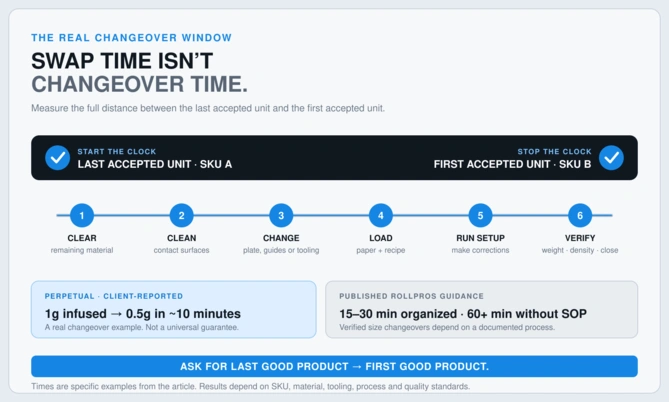
Ask how long a format change takes and you may hear the time required to swap one physical component. That isn’t necessarily the time between the last accepted unit from SKU A and the first accepted unit from SKU B.
A real changeover may include clearing the remaining material, cleaning contact surfaces, changing plates or guides, installing size-specific parts, loading the new paper, selecting or rebuilding a recipe, running a setup batch, checking weight and density, correcting the settings and deciding what to do with the units used for validation.
RollPros’ own guide to cone-size calibration says a well-organized production line may complete a verified size changeover in 15 to 30 minutes. Without a documented process, it says the same change may take more than an hour. The guide also makes the larger point plainly: every format should be treated as its own validated machine configuration, not as a casual accessory swap.
That’s the number buyers should request.
Not “How fast can someone replace the part?”
How long from the last good product to the first good product?
We’ve seen several versions of format flexibility across FlexPak customer floors, and they don’t all look the same.
Rebel Roots Farms produced 109 mm, 84 mm and 70 mm cone formats across a demanding multi-SKU schedule. For large orders, the team could dedicate a machine or one side of the production room to a specific SKU. For smaller half-day runs, alternate plates were stored under the worktable and changed as needed.
That allowed the operation to plan around the order instead of forcing every order into the same workflow. Dean reported that a 10,000-unit run could be completed in roughly four to five hours, moved into approximately 20 production bins and handed off when the packaging team was ready.
At Surterra, the strategy was different. One FlexPak line handled 0.35-gram dogwalkers while the other produced 0.5-gram and one-gram cones. The company didn’t need every machine doing every SKU at every moment. It needed a floor that could divide the work without shutting down the entire pre-roll operation every time the schedule changed.
Perpetual gives us the changeover version of the story. The company currently runs 0.5-gram and one-gram products, including distillate- and terpene-infused pre-rolls and infused two-packs. Dan reported moving from a one-gram infused SKU to a half-gram format in approximately ten minutes.
His explanation wasn’t especially technical:
“With this, I change a tray. That’s it.”
My Friend Processing shows why this matters when a new product is moving from testing toward commercial production. Its existing operation is built largely around cone production, but white-label customers began asking for straight-wall, cigarette-style joints. The company had previously made blunt-style products by hand, and the labor and material economics didn’t work in its market.
Ryan’s team tested straight-wall production on the FlexPak Edge and reported strong output during those runs. At the time of the interview, they were preparing to launch full production. We aren’t attaching a daily number before that full commercial run is established, but the testing was successful and the customer demand was already there.
“The straight-wall joints smoke better than the typical cone. I already have customers waiting for us to get those projects rolling.”
That is format flexibility in business terms. It’s the ability to evaluate a real order and decide whether it makes money, instead of rejecting it because the equipment made the decision years ago.
We should apply the same honesty to FlexPak’s own product line.
The FlexPak Max is built for cone production. The FlexPak Edge is designed for straight-wall joints, blunts and cones. Max doesn’t become Edge because someone changes a touchscreen setting. They are different platforms built around different paper formats.
Within those platforms, plates let operators change weights and sizes without replacing the entire production system. But every new SKU still needs to be tested against the actual paper, material, target weight, closure and quality standard. A quick plate change doesn’t excuse sloppy validation.
Before buying equipment, build a format map using the products the company sells now and the products it could realistically be asked to sell next.
For every SKU, write down:
- Paper geometry: cone, straight tube, roll or blunt wrap
- Length, diameter and filter or tip style
- Target weight and acceptable weight tolerance
- Standard or infused material and infusion percentage
- Closure style: twist, crown, fold or open end
- Single, two-pack, five-pack, ten-pack or another configuration
- Hardware and tooling required
- People required for the changeover
- Time from the last accepted unit to the first accepted unit
- Setup units, rejects and rework created during validation
- Finished, accepted output after the new SKU is running
- Additional equipment, tooling and consumables that must be purchased
Then do one more calculation that rarely appears in the sales deck:
Annual format cost = tooling and added equipment + changeover labor + lost production time + validation waste + format-specific maintenance and inventory
The machine with the fastest headline speed can still be the expensive choice if it takes half a shift to change products, needs a technician to do it or requires another six-figure platform when the market asks for a different shape.
On the other hand, don’t pay for flexibility the business will never use. If 95% of your demand is a stable one-gram cone and the remaining 5% is mostly sales brainstorming, a dedicated cone line may be the right answer. The point is to make that decision intentionally.
Ask the equipment company to walk through the next three SKUs, not only the easiest product you make today. Have them identify the required parts, expected changeover time, training level, output range and any change in finishing or packaging. If “it can run that” depends on a kit, a future engineering project or another machine, put that into the investment model now.
A pre-roll machine can be fast, accurate and beautifully engineered. If it only makes the product yesterday’s buyer wanted, it can still become the most expensive thing in the building that tells sales no.
Buy for the orders you have.
Make sure the equipment can survive the orders you haven’t seen yet.
Part 9 is next: Single-Point-of-Failure Risk. Because when one machine becomes the entire production plan, a bad Tuesday can become everybody’s problem.
See the real numbers on a FlexPak line.
The FlexPak Max and Edge deliver up to 49,248 packed-and-closed pre-rolls per shift with a 2–3 person crew. USA-built, no mandatory service contract, lifetime technical support.